Welcome to Soul Meditation’s Blog – All about Spirituality


The Principle of Mentalism is the first of the seven Hermetic principles: “The All is Mind; the Universe is Mental.” It teaches that everything you experience happens within mind, which makes your inner life the place where change begins.
Think of a day you dreaded for a week. You rehearsed the conversation, felt your stomach tighten, slept badly, and then it went fine, or never happened at all. Everything that wore you out took place in mind. This is the territory the first Hermetic principle maps.
In this guide I explain what the principle says, where it comes from, what THE ALL means, and where the teaching is easy to misread. I also give you six practices for working with it. It is the first law in the series that begins on the 7 laws of the universe, so if you are new to the Hermetic principles, start there for the full map.
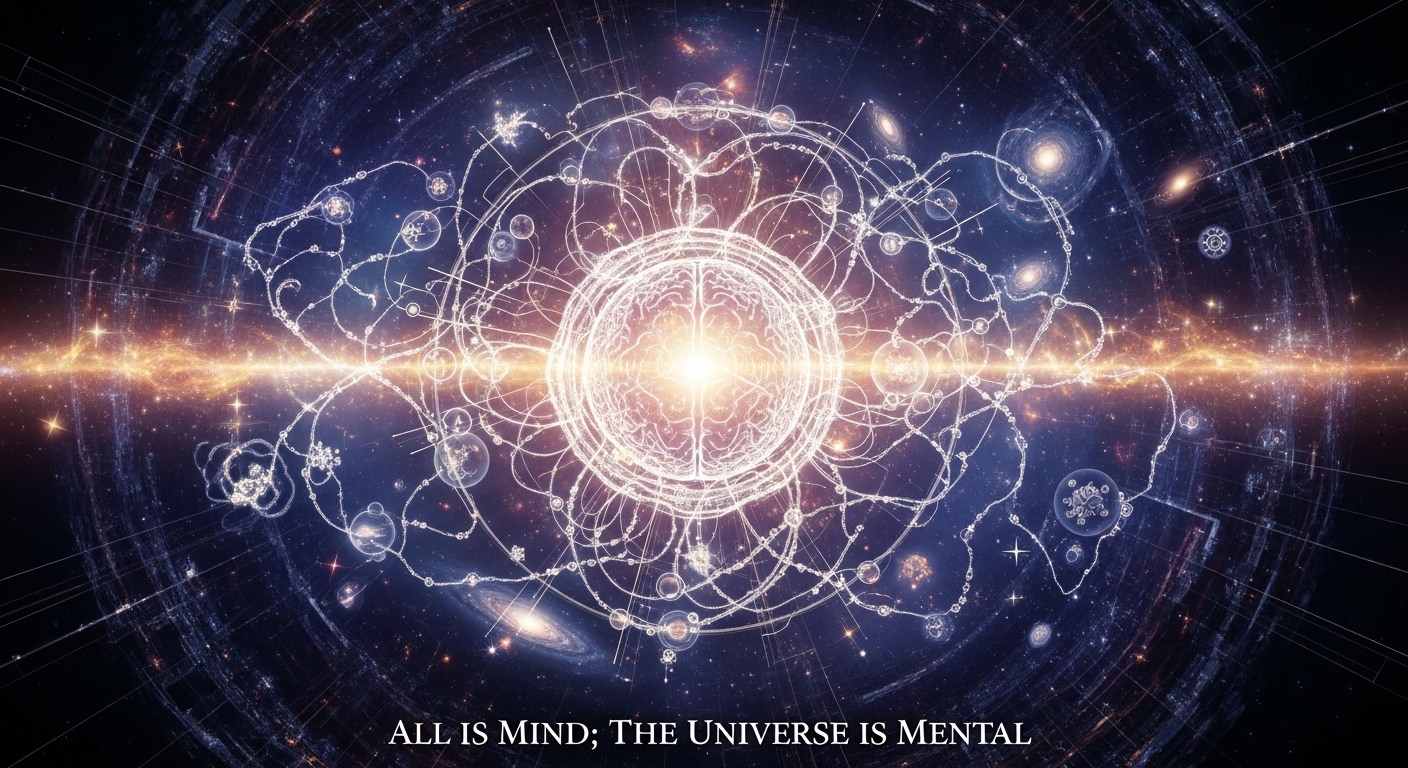
The Principle of Mentalism says that the Universe is mental: it exists within the Mind of THE ALL, the infinite source of everything, and every person, thought and experience is held inside that Mind. The Kybalion states it in one line: “THE ALL IS MIND; The Universe is Mental.”
Three ideas sit inside that sentence, and it helps to separate them.
- Mind comes first. Matter and energy are not the foundation. Consciousness is, and the physical world is how it appears.
- Everything is connected. If all things exist within one Mind, nothing is truly separate from anything else.
- Your mind is a smaller version of the same thing. Your thoughts work on your own world the way the Mind of THE ALL works on the Universe, similar in kind and very different in degree.
The Kybalion adds that this principle, by establishing the mental nature of the Universe, explains the many mental and psychic phenomena that people find puzzling. It also says that anyone who grasps it is “well advanced on The Path to Mastery.” I would put it more simply. This is the principle that makes the other six make sense, and it is why it comes first.
The list of seven principles comes from The Kybalion, a book published in 1908 under the name “Three Initiates” and presented as a summary of the teachings of Hermes Trismegistus, the legendary sage of the Hermetic tradition.
I want to be straight with you about the history, because many articles blur it. The older Hermetic writings, such as the Corpus Hermeticum, are Greek-language texts from the early centuries of the common era. They speak of God, the divine Mind and the soul’s ascent, and they do not set out a tidy list of seven principles. That list is the Kybalion’s own arrangement.
Does that make the teaching worthless? Not to me. I teach the seven principles as a spiritual framework, a practical way of looking at how mind, energy and experience relate, not as a documented historical lineage. The idea that mind is primary also appears well beyond the Kybalion. Philosophers call the view idealism, and it has a long history in Western thought, including the eighteenth-century philosopher George Berkeley. Mystical traditions across cultures say something similar in their own words. So the principle has company. Judge it by whether it helps you see your life more clearly. That is the test I use in my own work.
THE ALL is the Kybalion’s name for the substantial reality behind everything we see: Spirit, which in itself is unknowable and undefinable, but which can be thought of as an infinite, living Mind.
The book is careful on one point that many summaries skip. THE ALL is not the personal God of organized religion. The Kybalion warns against giving THE ALL human feelings and characteristics, such as jealousy or a hunger for praise. It is closer to the Tao of Taoism: a source that cannot be fully named, in which everything happens.
The Kybalion says the Universe, as a whole and in its parts, has its existence in this Mind, in which “we live and move and have our being.” According to the book, THE ALL is also infinite, cannot be added to or subtracted from, and cannot be confined. You do not need to picture it. Hermetic students were never asked to. They were asked to hold the idea lightly and notice what it changes in how they see their own mind.
If you come from a faith tradition, you can read THE ALL as God, as the Source, as the Universe, or simply as consciousness. Hermeticism has never required one fixed belief, which is part of why people from many backgrounds study it.
It means the Universe is a creation of Mind and exists within Mind. It does not mean the world is fake, imaginary, or something you can walk through if you believe hard enough.
This is the most common wrong turn, so it is worth slowing down. The Kybalion says the phenomenal world is a mental creation of THE ALL “subject to the Laws of Created Things.” In other words, once the world is created, it follows its own rules. A mental universe is still a lawful one. A table is still hard. Fire still burns. What the principle changes is where you place the source, not whether the experience is real.
Dreams are the easiest way I know to feel this. I have lucid dreamed since childhood, and the experience teaches the principle better than any book. In a dream, the sky, the ground and the people are all made of mind, yet while you are inside it everything feels solid. Only when you realize you are dreaming can you begin to work with the dream rather than being pushed around by it. The Hermetic claim is that waking life, on a far larger scale, has the same relationship to Mind.
The painting picture
Here is another image I use. Imagine a painting with two people in it. Each figure looks separate, but both are made of the same paint, and the same brushwork draws the landscape around them. If you look only at the figures, you see two beings. If you look at the painting, you see one thing expressing itself in many forms. That is the way I understand the Mentalism teaching that we are all connected, and it is also why every action sends a ripple through more than you can see.
No. The Kybalion is clear that you share in the creative power of Mind but are not THE ALL. It calls this the divine paradox: THE ALL is in everything, and everything is in THE ALL, yet no single thing is the whole.
The book gives the distinction directly: “THE ALL creates Universes in its own Mentality. But your Universe is the mental creation of a Finite Mind, whereas that of THE ALL is the creation of an Infinite. The two are similar in kind, but infinitely different in degree.” It also puts the paradox in a single line: “THE ALL is in the earth-worm, and yet the earth-worm is far from being THE ALL.”
This matters because the principle is often twisted into a more flattering and more harmful idea: that you alone are making up everyone and everything, so you are responsible for all of it. I have played with that thought as a meditation, imagining that I am creating this entire world with my mind. It is a useful stretch for the imagination. It becomes a problem when it turns into a belief. The Hermetic reading is gentler and more accurate. You are one finite mind inside an infinite one, with real influence over your own inner world and a real share in everything around you, but not sole authorship.
Holding both halves keeps you humble and empowered at the same time. You are neither a helpless bystander nor the architect of the cosmos. You are a participant, and a participant has choices.
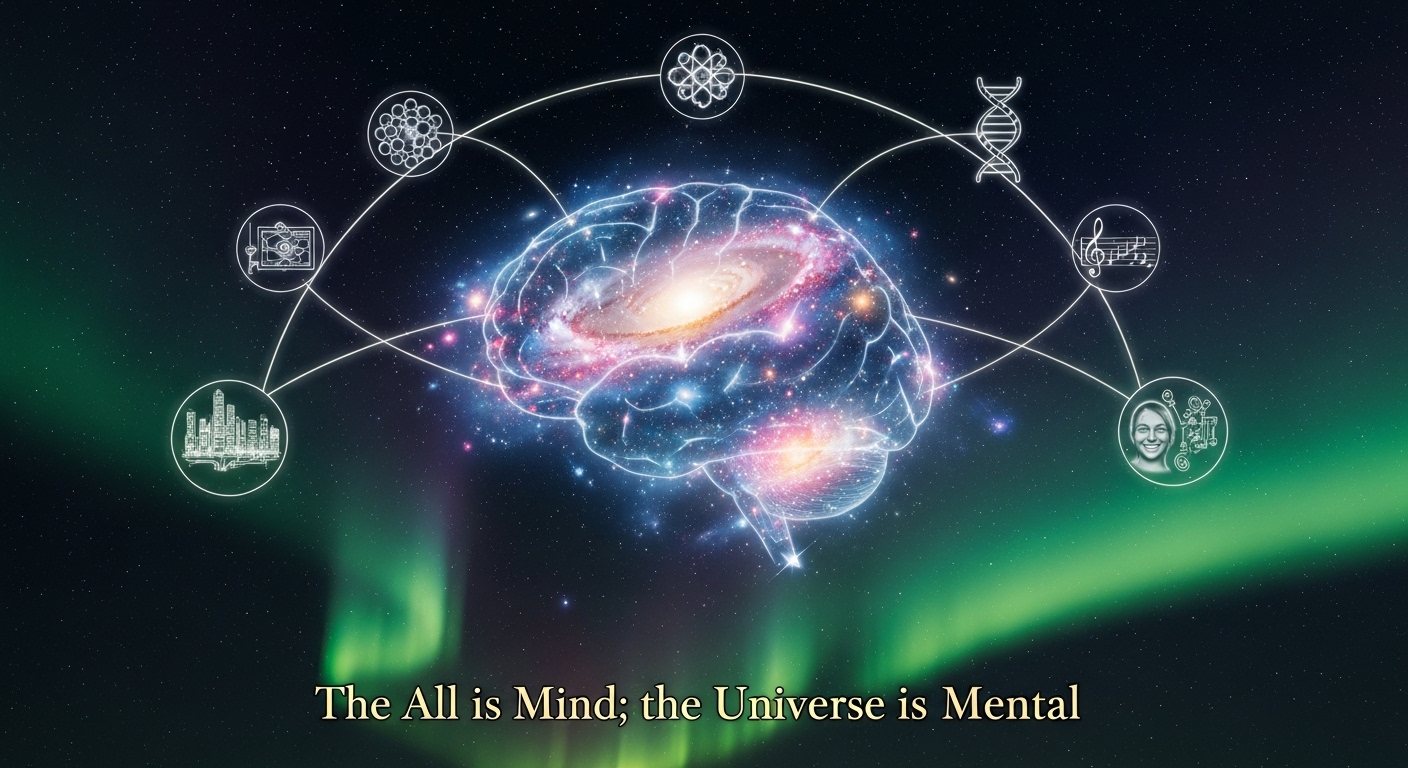
In the Hermetic teaching, your thoughts are the first cause of your experience, and they shape what you notice, how you feel and what you do next. That does not mean a thought alone can produce any outcome you like, and nobody can honestly promise you that.
Here is how I draw the line between what I can stand behind and what I cannot.
- What you can verify yourself: how you interpret an event changes how it feels. Two people can walk into the same meeting, and one feels threatened while the other feels curious. The meeting was the same. The mind that met it was not.
- What is a spiritual teaching: that thought also moves on subtler levels, linking you to other minds and to the wider Mind of THE ALL. I offer this as a framework to test in your own meditation, not as something I can prove on a lab bench.
- What I will not claim: that thinking positive thoughts guarantees a particular result, or that hard things in your life are there because you thought them into being.
That last point matters. Illness, loss and injustice are not proof that someone failed at Mentalism. If you are going through something heavy, the principle is a way of meeting it, not a verdict on you. Please also look after your health with qualified professionals alongside any spiritual work. What I teach is spiritual support, not treatment.
Mentalism is also not quite the same as the Law of Attraction. Attraction is one popular application of it, the idea that like draws like. Mentalism is the broader foundation underneath: the claim that mind comes first. Your inner state does not hand you results, but it does shape how you meet whatever arrives, and that shapes what comes next.
Mental transmutation, sometimes called mental alchemy, is the Hermetic practice of changing one mental state into another through deliberate use of the will. It is the practical payoff of Mentalism, and I think it is the most useful thing the Kybalion teaches.
The idea runs like this. If the Universe is mental and your mind is a small version of the same thing, then your mental states are not fixed facts about who you are. They are conditions, and conditions can be changed. Hermetic writers call this the “art of polarization,” because they see states such as fear and courage, or doubt and trust, as two ends of one scale rather than separate things. The Kybalion’s advice, as it is often quoted, is to put the Principle of Polarity to work: “concentrate your thought on the opposite pole of the one you want to annihilate.”
I read that carefully. It does not say to deny or crush what you feel. It says to turn your attention toward the other end of the same scale and let your state shift along it. If you are stuck in worry, you do not argue yourself out of worry. You ask what the calm end of this same feeling would look like, and you give that your attention for a few minutes.
The Principle of Polarity gets its own full treatment on its own page. And once you see that a mental state also has a rate of movement, you are standing in the doorway of the Principle of Vibration, which is the third law and teaches how your attention moves your state.
You practice Mentalism by becoming aware of your thoughts, questioning the stories they tell, and deliberately directing your attention. The six practices below are the ones I return to most, and none needs equipment or experience.
One note first: these are spiritual and self-care practices, not a treatment for any condition. If you are struggling with your mental health, please talk to a qualified professional alongside this work.
1. Watch your thoughts for five minutes
Sit quietly and treat your thoughts like traffic passing a window. Do not follow them or argue with them. Just notice, and silently label them: planning, worrying, remembering. The point is to discover that you are the one watching, which is not the same as the thoughts themselves. This is the core move of Mentalism, and everything else builds on it.
2. Separate the event from the story
When something upsets you, write two lines. First, what actually happened, in plain facts a camera could record. Second, what you are telling yourself about it. “My friend did not reply” is an event. “She is angry with me” is a story. Often the story is doing most of the damage, and you only see that once it is on paper.
3. Choose one thought to hold
Pick a single steady thought, such as “I am safe in this moment” or “I can take the next step,” and hold it through ten slow breaths. Do not force a feeling. Just let that one thought be the object of your attention. This trains the Kybalion’s idea that the will can direct the mind.
4. Visualize with feeling
Picture something you are working toward, but spend less time on the image and more on how it would feel to be there. Thought and emotion work together in the mind, and a picture with no feeling tends to fade quickly. If you prefer to be guided, my guided meditations are recorded for this kind of focused, relaxed attention.
5. Pair the thought with a small action
A thought you never act on stays a daydream. After any visualization, choose one small, real action within the next day, such as sending the message, booking the class or clearing the desk. Mentalism says mind comes first. It does not say mind is enough on its own.
6. Sit with the oneness reflection
Close your eyes and imagine the painting from earlier: you and the people around you as figures made of one paint. Think of one person you find difficult and quietly acknowledge that they too are held within the same Mind. You are not required to like them or excuse anything. Many people find this softens the grip of resentment, and it is the most direct way I know to feel the connection side of the principle.
Consistency matters more than intensity. Five honest minutes a day will teach you more about this principle than an occasional long retreat.
Mentalism is the foundation the other six stand on. If the Universe is mental, each of the remaining principles describes how Mind behaves.
| Principle | How it connects to Mentalism |
|---|---|
| Correspondence | “As above, so below.” The same patterns repeat at every level because it is one Mind, and your inner world mirrors the outer one. |
| Vibration | Mind is in motion. Thoughts and emotions have a rate and mode, and attention is how you change them. |
| Polarity | Mental states sit on a scale between two poles, so you can move from one end toward the other. |
| Rhythm | Mind swings like a pendulum. Low moods are part of the swing, not a verdict on you. |
| Cause and Effect | Your thoughts are causes. What you do from them produces effects you can trace. |
| Gender | Mind has receptive and active sides, and creating anything starts with both. |
For the whole sequence in one place, with a short explanation of each law, go to the 7 laws of the universe.
Because “mind over matter” has become a slogan, the teaching often gets flattened. These are the five distortions I see most.
- “Nothing is real, it is all in your head.” The principle places the world within Mind, not inside your personal head. The world still follows its own laws.
- “You create everything that happens to you.” You influence how you meet events and what you do next. You are a finite mind inside an infinite one, not the sole author of reality.
- “Positive thinking is the same as Mentalism.” Forcing a smile over real pain is avoidance. Mentalism asks you to observe your thoughts honestly first, and then direct them.
- “If you think it, you will get it.” A thought can shape your attention and your choices. It does not control other people or promise a result.
- “It is a proven science.” It is a philosophical and spiritual framework. Parts of it overlap with ideas people can test for themselves, such as how interpretation changes feeling, but the principle as a whole is a way of seeing, not a laboratory finding.
Q: What is the Hermetic principle of Mentalism?
It is the first of the seven Hermetic principles, and it states that “THE ALL IS MIND; The Universe is Mental.” Everything exists within the Mind of THE ALL, and your own mind is a smaller expression of the same thing.
Q: What are the 7 principles of Hermeticism?
In the Kybalion they are Mentalism, Correspondence, Vibration, Polarity, Rhythm, Cause and Effect, and Gender. I explain each one on the 7 laws of the universe page.
Q: Do Hermetics believe in God?
It depends on the tradition. The Kybalion speaks of THE ALL, which it describes as Spirit and infinite living Mind, and warns against picturing it as a human-like deity. Many readers understand THE ALL as God or as the source of everything. The older Hermetic texts speak more directly of God and divine Mind.
Q: Is The Kybalion actually Hermetic?
It draws on Hermetic themes and uses Hermes’ name, but it was published in 1908, and its list of seven principles is its own arrangement rather than a quotation from ancient Hermetic scripture. I treat it as a useful modern framework inspired by Hermetic ideas.
Q: Is the Principle of Mentalism the same as the Law of Attraction?
No. Mentalism is the broader teaching that mind comes first. The Law of Attraction is one popular way of applying it. I cover that side separately in my guide to the Law of Attraction.
Q: Can Mentalism help with a busy or anxious mind?
The practices above, such as watching your thoughts and separating event from story, can be calming for many people. They are spiritual and self-care tools, not a treatment, so please see a qualified professional if anxiety is affecting your daily life.
If you would like guided help putting the Hermetic principles to work, you can explore the spiritual courses I teach. And if you would rather simply receive a calming practice, I will send you a free guided meditation when you subscribe here.


The Principle of Mentalism asks you to take your own mind seriously. If everything unfolds within Mind, then how you think, what you give your attention to and the stories you believe are not side issues. They are where your experience starts. You are not in charge of everything, but you are in charge of more than you were told.
Start with the first practice. Watch your thoughts for five minutes a day for a week, and notice what you find when you stop arguing with the traffic.
Love & Light,
Rev. Fernando Albert