

Welcome to Soul Meditation’s Blog – All about Spirituality


You can astral project and lucid dream with aphantasia. You swap picture-making for sensation, sound and emotion, and you use the wake-induced method, which asks you to stop forming images anyway.
Almost every guide says the same thing: close your eyes, picture a rope, picture yourself floating up, picture the room below you. If you read that and your mind stays dark, it is easy to decide this practice was never meant for you.
It was. This guide is written for people who cannot form mental pictures. It covers how to enter the state, how to stay in it, and how to hold on to the memory afterward, using the senses you do have. I am a spiritual teacher, not a mental health practitioner (see my legal page), so nothing here is a diagnosis or a treatment. It is practical spiritual guidance, drawn from what people with aphantasia have told me about their own practice.
Aphantasia is the inability to create mental pictures on purpose. Ask a person with aphantasia to imagine a red car or the face of someone they love, and nothing appears. They know what the car looks like. They simply cannot see it in the mind’s eye. The term was coined in 2015 by the neurologist Adam Zeman and his colleagues.
It is more common than most people think. Cleveland Clinic says experts estimate that between 2% and 4% of people have it, describes it as a difference in how a mind works rather than a disorder, and notes that many people never realize they think differently until they hear the word. It also points out that the condition comes in degrees: some people never see mental images, others get brief involuntary flashes, and some do not see images in their dreams.
Does that stand in the way of astral travel? In my teaching, no. Aphantasia is not a permanent block and it is not a dead end. It means the standard route, which leans on visualization, needs a different route. People with aphantasia have written to me again and again asking whether they can learn to astral project, and my answer is yes, with adjustments. Those adjustments are the rest of this page.
One note on language. Aphantasia, as the research literature uses the word, describes imagery you create on purpose. Some people still dream in pictures, and some get unbidden flashes. Where you sit on that range changes which tips below will matter most to you, so try them all.
Most astral projection instructions are written by and for people who see pictures. They tell you to imagine a silver cord, picture the exit door, see yourself rising. For a non-visualizer these are not instructions, they are puzzles with no solution, and failing them feels like a personal failure.
It is not. The instruction is the problem. What those steps are really trying to give you is a sense of lightness, separation and movement. Pictures are one way to evoke that sense. Feeling is another, and it is the more direct of the two.
Here is a quick translation table you can keep in mind whenever you read a technique elsewhere:
| The instruction says | Do this instead |
|---|---|
| Picture yourself floating above your bed | Feel the weightlessness of floating, as if you were resting on water or air |
| See a rope hanging above you | Notice the pull of your hands closing around a rope, the tension, the effort of climbing |
| Imagine a bright white light | Feel warmth spreading through your chest and shoulders |
| Visualize your dream scene forming | Listen for the sounds of the scene: waves, wind, voices |
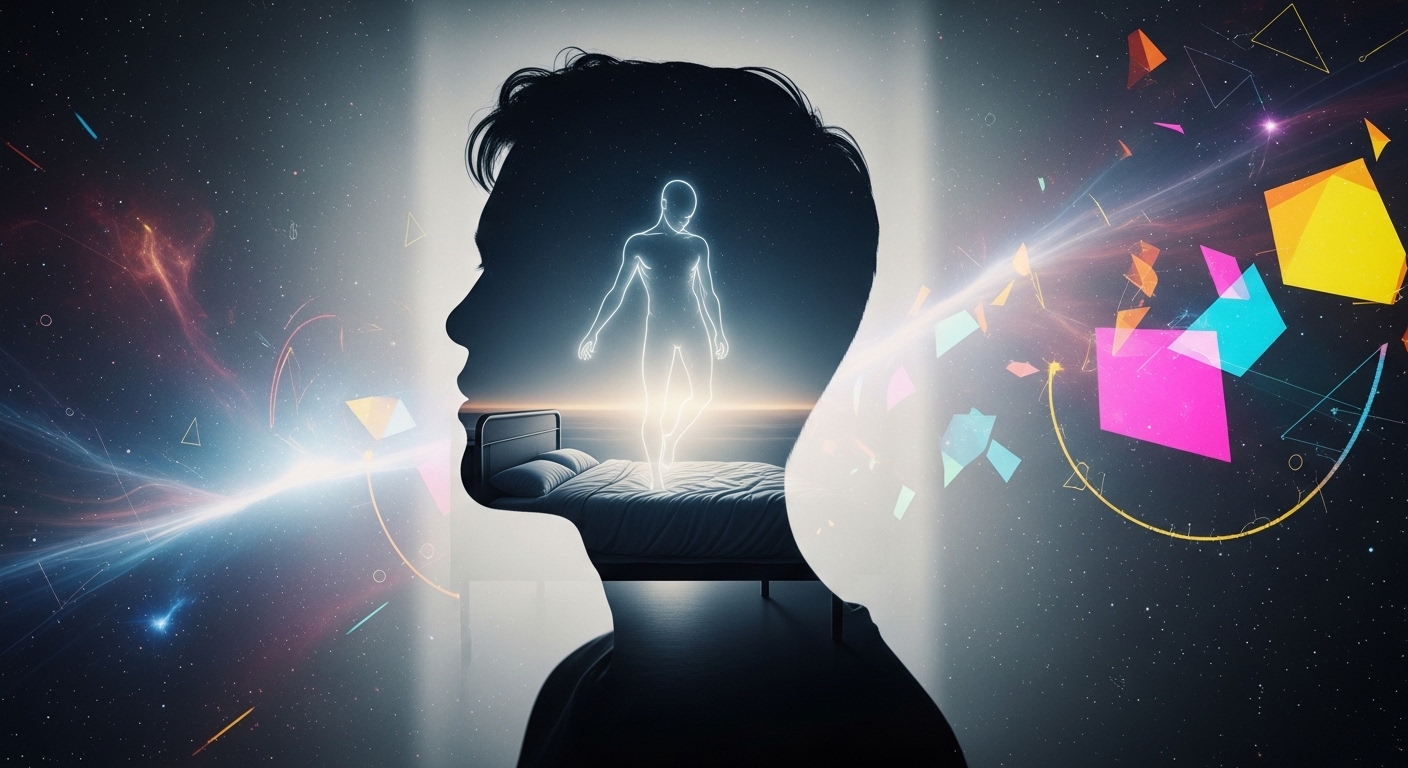
Once you start translating, a lot of the techniques on this site become usable. If you find one on the blog that appeals to you, strip out the visual parts and strengthen whichever other senses it touches.
The easiest route is the wake-induced technique, often called WILD (wake-induced lucid dream). It works for both astral projection and lucid dreaming, and it suits non-visualizers for a simple reason: its main requirement is that you stop producing images. A few people with aphantasia have told me they feel they have an advantage here, and I will come back to that below.
Step 1: Choose the right moment
The best time is after you wake in the middle of the night or very early in the morning. Your body is already heavy with sleep, and your mind has less momentum. Lie on your back and let your breathing slow.
Step 2: Relax your body completely
Work through the body from the feet up, noticing each area and letting it go. This is a physical scan, not a picture. You are checking in with sensation: the weight of your legs, the warmth of the blanket, the rise of your belly. Do not try to hold any images. For most people that is the hard part. With aphantasia it takes care of itself.
Step 3: Enter the threshold
When your body is deeply relaxed and your mind stays quietly awake, you may enter sleep paralysis, the stage in which the body is asleep and you are not. You may notice vibrations, a hum, or a feeling of heaviness. For a more detailed look at this stage, read about sleep paralysis.
Many people who can visualize report frightening images at this point. People with aphantasia tell me they are spared that part, because no pictures form in the mind. You may still hear sounds that are not there and feel physical sensations that are not real, such as pressure on the chest or a presence in the room. Treat them as passing weather. Breathe slowly, remind yourself you are safe in bed, and let them go by.
Hold on to the most important thing about this stage: you are one step away. The difficult part, a still body and a quiet mind, is already done.
Step 4: Move by feeling, not by seeing
Here is where the translation work pays off. Ignore any strange sounds and bring up the feeling of freedom. Recall a moment of real joy and let that emotion fill you. If you have had an astral or lucid experience before, recall how it felt at that time.
Then, to leave the body:
- Feel lightness. Focus on the sensation of floating, as if the air itself were holding you up.
- Feel the bubble. You cannot see a bubble, but you can feel what floating inside one would be like: weightless, loose, rising slowly.
- Expand the vibrations. If you notice vibrations, give them your whole attention. Do not picture them. Feel exactly how they register in your body, then let that feeling widen, as if it were spreading outward past your skin.
Stay with the sensation until the sense of separation arrives. Do not force it. If you slip into sleep, that is normal. Try again another night. If you want to see how the full process looks for someone who does visualize, my guide to astral travel walks through every stage and exit technique, and you can apply the same translation table to it.
The same wake-induced method applies. The only difference is what you do at the threshold.
To move from the threshold into a lucid dream, tell yourself clearly, in words, that you are dreaming. You do not have to watch a dream scene form. Instead, listen for it. If you want to dream of the beach, bring up all the sounds a beach has: the rhythm of waves, gulls, wind passing over sand, distant voices. Then add touch, the warmth of the sun on your skin and a breeze on your face. In a short time you may find yourself inside a dream, fully lucid.
This is the logic behind the approach. A dream is not just a picture show. It is an environment you can hear, feel and move through. If your imagery is weak, you are not locked out of the environment. You are simply entering through a different door.
People who practice daytime habits tend to progress faster, so use non-visual reality checks too. Instead of looking at your hands, press a finger against your palm and ask yourself whether you can feel the pressure exactly as you would when awake. Or pay attention to how sounds behave: do they sound sharp, or oddly muffled? For a fuller introduction to the whole practice, see my lucid dreaming guide. If it turns out to be a harder road for you than astral travel, which does happen, that extra difficulty will not stop you. Practice does the rest.
If the steps above feel abstract, spend a week or two strengthening the senses you will rely on. This is simple, daytime practice and takes only a few minutes.
- Sound. Choose a sound you know well, such as ocean waves or a favorite singer’s voice. Close your eyes and try to hear it in your mind. Many people with aphantasia find that inner sound is easier than inner pictures. A good test: you probably can “hear” the voice of someone you love even though you cannot see their face.
- Touch. Rest your hands on a warm cup, then put it down and try to recall the feeling of the warmth in your palms.
- Movement. Remember the physical feeling of flying in a swing, diving into a pool or riding in an elevator. These bodily memories are the raw material for the floating sensation in astral travel.
- Emotion. Practice summoning a feeling on purpose: calm, joy, freedom. This is the skill you will lean on most at the threshold.

A gift: four minutes of sound practice
I recorded a short four-minute audio file for this purpose, which uses sounds instead of pictures to train your attention. You can download it here and use it before bed or during the day.
This is the most delicate part. When you come back from a vivid dream or an astral journey, someone with aphantasia cannot replay it as a picture. The inner screen stays blank, just as it does when you try to imagine anything else. That emptiness can make it feel as though nothing happened.
It did happen. You are simply storing it in a different format. Experiences are not only visual. Here is how to bring them back.
- Write down sounds first. If you dreamed of a beach, you can still describe the waves, the wind and the voices. Sound is often the richest source of detail.
- Write down touch. The air on your face, the sense of speed, the weight or weightlessness of your body.
- Write down what you felt. Joy, freedom, calm, curiosity, fear. Name each one.
- Add the bigger picture. In the astral, many people report deep feelings of freedom, unconditional love, unity and peace. These perceptions are emotional, mental and spiritual rather than visual, so they suit aphantasia well.
Even if you cannot see what you saw in a flying dream, you can recall how the air felt against your face, the sound of your own flight, and what it felt like to be that free. That is a lot of information.

Feelings are also the memories that stay longest. You can relive them later, even without a single image. Keep a notebook by the bed and write as soon as you wake, before the details fade. If you want to understand what is happening in the dream state more broadly, my page on remembering your dreams goes further.
I can’t promise it, and I want to be careful. But a number of people with aphantasia have told me that they quiet their minds more easily, because there is no stream of pictures to quiet. The wake-induced method depends on exactly that: a still body, a still mind, awareness intact. For them, the first stage that frustrates other practitioners is where they feel at home.
That is a personal report, not a scientific finding, and it will not be true for everyone. Plenty of people with aphantasia find the practice no easier than anyone else. Treat it as an encouraging possibility, not a guarantee. The practical point is this: you start with real strengths, and none of them is a weakness to overcome.
If your imagery changed recently, or if you lost it after an illness or injury, that is a question for a doctor, not for a meditation teacher. Cleveland Clinic notes that acquired aphantasia almost always follows an injury, illness or mental health condition, so it is worth getting checked.
Q: Can you astral project with aphantasia?
Yes. Aphantasia changes the route, not the destination. Use the wake-induced method, stay with feeling and sound instead of pictures, and be patient with the threshold stage.
Q: Is aphantasia astral projection harder?
It depends on the person. Visualization-heavy techniques are harder, so avoid them. Techniques built on relaxation, sensation and intention are not harder, and some people tell me they are easier.
Q: What is the best technique for aphantasia astral projection?
Wake-induced entry, followed by a feeling-based exit: lightness, floating and expanding vibrations. See the steps above.
Q: Can you lucid dream with aphantasia?
Yes. Tell yourself in words that you are dreaming, build the dream from sound and touch, and use non-visual reality checks.
Q: Can people with aphantasia see in the astral?
Reports differ. Many people describe the astral as being more about feeling than seeing, and tell me that the visual side takes a back seat even for those who can visualize. Your experience may be rich in sound, sensation and emotion.
Q: How do you remember an astral experience with aphantasia?
Write down sounds, physical sensations and emotions as soon as you wake. These carry the memory in place of pictures.
Q: Do people with aphantasia dream?
Yes. Cleveland Clinic notes some people with aphantasia do not see images in their dreams, while others do. Either way, you can dream and become lucid.
Q: Is aphantasia a medical condition?
Cleveland Clinic describes it as a difference in how the mind works, not a disorder or disability. I am not a medical professional, so for any health question please talk to your doctor.
Everything above is a how-to, and it works with no purchase at all. If you would like guided support, I created meditations that never ask you to see anything. They work with your breath, body sensations, emotions and energy awareness instead. You can read how they work in my guide to aphantasia meditations, or go directly to the aphantasia meditations collection.
To read more around this topic, try the guides on lucid dreaming and astral projection, the difference between the two, and learning astral projection.

A blank mind’s eye is not a closed door. Astral travel and lucid dreaming are made of presence, feeling, sound and intention, and you have all of them. Start with the wake-induced method, build the dream from what you can hear and feel, and write down every sensation when you wake. The memory will be there, in the form you can read.
Love & Light,







2 thoughts on “Aphantasia and Astral Travel: A Teacher’s Guide for Non-Visualizers”
How is lucid dreaming gonna help with aphantasia? I don’t see stuff while dreaming. That’s how I realize that I’m dreaming…
While Aphantasia is a big block in dreaming, it doesn’t mean you can’t dream at all. Are you able to hear things? If so, you already have something, but otherwise, you still will be able to experience your dreams through feelings, as well as through physical sensations. Some people who cannot see stuff will know stuff out of the blue through claircognition. These are ways that you can be above Aphantasia, and experience stimuli through other ways versus seeing.